5 Hidden Features of the Turtle Beach Velocityone Race Kd3 You Must Know About
The landscape of sim racing peripherals has undergone a radical transformation over the last decade. What was once a niche hobby reserved for those with deep pockets and professional-grade cockpits has evolved into a mainstream competitive endeavor. As direct drive technology becomes the gold standard for immersion, manufacturers are looking for ways to differentiate their offerings beyond just raw torque figures. The Turtle Beach Velocityone Race Kd3 has emerged as a formidable contender in this space, promising a high-fidelity experience that bridges the gap between console convenience and PC-grade performance. While most reviewers focus on the 7.2Nm of peak torque or the modular design of the pedals, there are several sophisticated engineering choices and software-driven features that often fly under the radar during a cursory setup.
Buyers in the modern market are increasingly savvy; they care about sustained performance, thermal management, and the flexibility to tune their equipment for different racing disciplines, from drifting to endurance GT3 sessions. The Velocityone Race Kd3 is designed to cater to these nuances through a combination of integrated hardware and intelligent firmware. Understanding the deeper layers of this ecosystem is essential for any racer looking to shave tenths off their lap times or simply enjoy a more authentic tactile experience. In this detailed analysis, we will explore the technical architecture of the Kd3 and delve into the hidden features that make it a standout choice in the crowded direct drive marketplace.
Advanced Hardware Analysis: More Than Just a Steering Wheel
At the heart of the Turtle Beach Velocityone Race Kd3 is a custom-engineered direct drive motor. Unlike gear-driven or belt-driven systems of the past, the motor is connected directly to the steering column, eliminating the mechanical loss and "notchy" feel that can plague entry-level systems. This direct connection allows for instantaneous feedback, translating the vibrations of the road, the loss of traction, and the weight transfer of the vehicle with startling clarity. However, the Kd3 goes a step further by implementing a high-resolution absolute encoder. This component tracks the position of the wheel at a granular level, ensuring that the software calibration never drifts, even after hours of aggressive counter-steering during a rally stage.
The build quality also warrants a deep look. The rim itself is wrapped in hand-stitched materials that balance grip and comfort, but it is the internal magnesium alloy frame that provides the necessary rigidity. This choice of material is critical because it keeps the rotational mass low, allowing the motor to accelerate and decelerate the wheel with minimal inertia. For the end-user, this translates to "snappy" feedback that feels alive rather than heavy. When combined with the high-bandwidth data transmission between the base and the wheel, the Kd3 minimizes input lag, a factor that is often the difference between catching a slide and spinning into a barrier.
1. The Integrated Race Management Display (RMD) Deep Diagnostics
The first hidden feature that many users overlook is the sheer depth of the Race Management Display (RMD). While it is easy to view it as a simple dashboard for speed and gear selection, it is actually a sophisticated diagnostic and tuning portal. Most sim racers are used to alt-tabbing out of their game to adjust force feedback settings in a separate PC application. The Kd3 RMD allows for real-time telemetry-based adjustments without interrupting the flow of a race. One can adjust the "Spring" and "Damper" settings independently based on the specific car being driven.
Moreover, the RMD features a hidden diagnostic mode that shows internal motor temperatures and voltage stability. This is a game-changer for endurance racers. Knowing that your motor is running within its optimal thermal window during a two-hour stint at Spa-Francorchamps provides peace of mind. If the system detects overheating, it can subtly adjust the force feedback curve to protect the hardware without a sudden loss of power, a feature Turtle Beach calls "Thermal Intelligence." Understanding how to monitor these metrics through the RMD allows a driver to push the hardware to its absolute limit without fear of long-term degradation.
2. K-Drive Enhancement Engine: The Secret Sauce of Tactile Feedback
Force feedback is often misunderstood as simply "resistance" or "vibration." True fidelity comes from the ability to represent high-frequency data—like the hum of a rumble strip or the gritty texture of gravel—simultaneously with low-frequency data like the heavy pull of a high-speed corner. The Velocityone Race Kd3 utilizes a proprietary K-Drive enhancement engine. This is a digital signal processing (DSP) layer that sits between the sim software and the motor controller.
The "hidden" aspect here is the ability to customize the K-Drive profiles for specific titles. Rather than a one-size-fits-all approach, the firmware includes pre-baked algorithms that interpret the physics engines of popular titles differently. For instance, in a title focused on tire deformation, the K-Drive engine can be set to prioritize "sidewall flex" sensations. In more arcade-leaning titles, it can boost the sensation of "speed-sensitive weight." By diving into the advanced settings of the companion app, users can unlock "Direct-to-Drive" mode, which bypasses certain windows-level filtering and provides a raw, unfiltered data stream for the most hardcore simulation enthusiasts.
Shop the latest Electronics picks on Amazon.
Browse Now →3. Dynamic Load-Cell Pedal Calibration and "Brake-By-Wire" Simulation
The pedals included with the Velocityone Race system are often praised for their load-cell technology, but the hidden feature lies in the firmware-based brake pressure mapping. Traditional hydraulic brakes in real race cars do not behave linearly; they have a "bite point" and a specific curve as the fluid compresses. The Kd3 pedals allow users to simulate this through the "Brake-By-Wire" software setting. Many users simply plug the pedals in and use the default 0-100% linear ramp. However, by accessing the advanced calibration menu, you can set a non-linear curve that mimics the feel of a GT3 braking system.
This allows for much more precise trail braking. You can set the first 20% of the pedal travel to be highly sensitive for subtle weight transfers, while the final 30% requires significant force to trigger ABS, preventing lock-ups. This level of customization is usually only found on standalone pedal sets that cost as much as the entire Kd3 bundle. Furthermore, the pedals feature adjustable pre-load springs that can be swapped or tensioned to match the physical resistance of different vehicle classes, from the soft pedal of a road-going hatchback to the rock-hard sensation of a formula car.
4. Modular Expansion Ports and Future-Proofing
Digital peripherals are often criticized for their lack of longevity as new standards emerge. Turtle Beach has addressed this through a series of "hidden" expansion ports located on the rear of the wheel base. While there are obvious ports for the pedals and the power supply, there are additional high-speed data ports designed for future modularity. These are not merely for show; they utilize a proprietary communication protocol that allows for the addition of sequential shifters, handbrakes, and even secondary telemetry displays without saturating the USB bandwidth of the host console or PC.
This "closed-loop" ecosystem ensures that as you grow in your sim racing journey, you won't need to replace the core base unit. You can add a heavy-duty handbrake for rally stages or a gated shifter for vintage racing, and the Velocityone system will recognize these units natively. This architecture also allows for future "haptic" expansions, such as seat vibrators or "butt-kickers," to be synced directly with the K-Drive engine for a fully synchronized physical experience that goes beyond just the hands.
5. Seamless Cross-Platform "Vibe" Migration
One of the biggest headaches for sim racers who play on both Xbox and PC is the discrepancy in force feedback feel between platforms. Often, a wheel that feels great on PC feels "numb" on console due to the way different operating systems handle HID (Human Interface Device) controllers. The Velocityone Race Kd3 features a "Platform Bridge" firmware feature. This allows the wheel to store multiple onboard profiles that are specifically tuned to compensate for the limitations of console API standards.
If you have spent hours perfecting a "smooth and heavy" feel on your PC setup, you can save that profile and "migrate" the vibe to your console. The wheel base's internal processor handles the translation of the data, ensuring that your muscle memory remains intact regardless of where you are racing. This is particularly useful for competitive racers who may practice on PC but compete in console-based leagues. The ability to maintain a consistent tactile "handshake" with the machine is an underrated advantage that the Kd3 provides through its internal memory buffer.
Detailed Comparison of Market Competitors
To truly understand the value proposition of the Turtle Beach Velocityone Race Kd3, it is helpful to see how its features stack up against other direct drive systems in the same torque bracket. The following table highlights key differences in integrated technology and customizability.
| Feature | Velocityone Race Kd3 | Standard DD Competitor A | High-End Modular System B |
|---|---|---|---|
| Peak Torque | 7.2Nm (Direct Drive) | 5Nm - 8Nm | 10Nm + |
| Integrated Display | Full Color OLED RMD | Simple Segment LED or None | External Accessory Required |
| Pedal Tech | Load-Cell with Curve Tuning | Potentiometer (Standard) | Hydraulic or High-End Load Cell |
| Tactile Audio Processing | K-Drive Enhancement Engine | None (Standard LFE) | Third-Party Software Needed |
| Connectivity | Xbox & PC Native | Usually Single Platform | PC Only (Usually) |
Pros & Cons of the Velocityone Race Kd3
Every piece of hardware involves trade-offs. The Kd3 is designed to be an all-out solution, but depending on your space and goals, certain aspects might be more relevant than others.
Looking for the best Electronics deals on Amazon?
View Offers →- Pro: All-in-One Ecosystem - Unlike many direct drive bases that require you to buy wheels and pedals separately, the Kd3 provides a cohesive experience out of the box, saving the user from compatibility headaches.
- Pro: Real-Time Tuning - The ability to adjust force feedback settings on the fly via the RMD display is a revolutionary convenience for those who hate navigating menus mid-session.
- Pro: Silent Operation - The direct drive motor is nearly silent, making it an excellent choice for racers who live in apartments or share a household, where the clattering of gears would be disruptive.
- Pro: High-Fidelity Audio Integration - Integrated audio controls and superhuman hearing presets for headsets provide a competitive edge in hearing tire scrub and opponent proximity.
- Con: Desk Mounting Challenges - While it comes with a desk clamp, the 7.2Nm of torque is substantial. Users with thin or unstable desks may find that the force moves the entire table rather than just the wheel.
- Con: Rim Specificity - Currently, the ecosystem is built around the provided rim. While modular, those wishing to use third-party "real" steering wheels may find the proprietary mounting system restrictive without future adapters.
- Con: Software Complexity - The sheer volume of tuning options can be overwhelming for a beginner. It takes time to learn the relationship between "Damping," "Friction," and "Inertia."
Buying Guide: Is the Velocityone Race Kd3 Right for You?
Choosing a sim racing setup is a significant investment, and the Turtle Beach Velocityone Race Kd3 occupies a specific sweet spot in the market. To determine if this is the right purchase, you must first assess your current hardware and your long-term goals. If you are currently using a gear-driven wheel and find that the "clacking" sounds and lack of detail are holding you back, moving to the Kd3 will feel like a generational leap. The transition from 2Nm or 3Nm of torque to 7.2Nm is profound, providing the physical feedback necessary to feel the car's limits.
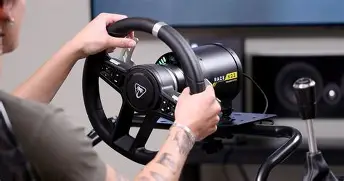
Consider your primary platforms. One of the strongest selling points of the Kd3 is its native support for Xbox. For console players, the options for high-quality direct drive have traditionally been limited. The Kd3 treats the console experience with the same respect as the PC experience, offering features that were previously "PC only." If you are a cross-platform gamer, this is arguably the most versatile hub on the market. Furthermore, look at your cockpit setup. If you have a dedicated sim rig, the hard-mounting points on the Kd3 base and pedals make for an rock-solid installation. If you are a desk racer, ensure your desk is sturdy enough to handle the rotational forces.
Another factor to consider is whether you prefer a "plug-and-play" experience or an "infinite-tuning" experience. The Velocityone Race Kd3 caters to both, but it rewards the latter. If you are the type of racer who enjoys delving into telemetry, adjusting brake bias for every corner, and fine-tuning the feel of the road, the "hidden" software features mentioned earlier will provide endless value. If you simply want to drive, the default profiles are excellent, but you are paying for a level of engineering depth that begs to be explored.
For those interested in "immersion" over "competition," the K-Drive engine is a significant draw. The ability to feel the engine's vibration through the rim adds a layer of sensory input that makes the experience feel less like a game and more like operating a complex machine. When assessing the cost, remember that you are getting a high-quality rim, a powerful base, and a professional-grade pedal set in one package. When compared to buying these components as "separates," the Kd3 offers a compelling value proposition for the mid-to-high-end enthusiast.
Conclusion
The Turtle Beach Velocityone Race Kd3 is a sophisticated piece of electronics that belies its straightforward appearance. By integrating features like the Race Management Display for real-time diagnostics, the K-Drive enhancement engine for textured feedback, and the highly customizable Load-Cell pedals, Turtle Beach has created a system that grows with the driver. It isn't just about the strength of the motor; it is about the intelligence of the system responsible for delivering that power. Whether it is the ability to migrate your favorite "feel" across platforms or the modularity that promises a long lifespan, the Kd3 is designed to be the centerpiece of a serious racing hobby.
Understanding these hidden features allows users to move beyond the basic setup and truly tailor the machine to their driving style. Sim racing is fundamentally a game of information—the more clearly you can receive data from the virtual tires, and the more accurately you can translate your intentions through the pedals, the faster you will be. The Kd3 provides the tools necessary to bridge that gap. As sim racing continues to evolve, having a base that is built on modularity and high-speed data processing ensures that you remain at the front of the grid for years to come. For the enthusiast seeking a balance of power, precision, and multi-platform versatility, the Velocityone Race Kd3 stands as a benchmark in modern sim racing design.